I have not published a blog for a while as I have been working on a book. It is a kind of memoir. I have decided to publish a prologue here as an experiment.
Everybody has a story.
I have a little furnished room inside my mind. It is a comfortable place, a world of its own in which all that I see and experience is interpreted and played with, matched and sorted, untangled or woven.
It is my world of dreams and reality is sifted through it.
My journey to find the light has required many walks in the valley of the shadows. It is said that the name Helena means sun, and therefore light, truth finder, shining the light creates shadows, shadows are found in both sunlight and moonlight.
I believe that understanding one’s own ancestors and one’s roots are very helpful in understanding oneself.
My father’s mother’s mother was a Helena (she was of Jewish birth) and my father’s father’s mother was a Norah (and came from a Christian background.) The name Norah refers to the moon. The moon rules over the tides and the water. The emotions and subconscious dreams. Both sun and moon consciousness are valid, both reveal truths we need to know.
My mothers, mothers father grew up on the Island of St. Helena. His father and his father’s father had been governors of the Island. Islands are places of extreme isolation from society, yet deep connection with nature.
“You have a lot of Helena’s in your background”, was my mother’s explanation for naming me Helena. But my family never called me Helena.
My parents preferred to call me Doë, which is my second name.
They used it because they thought it was a cute name for a baby. (Or so my mother says.)
“May Angels Guard her.” Is what my namesake Doë Howard wrote on a card accompanying a silver Ionic cross, she sent for my Christening from England. My mother kept it in a velvet box until I was old enough to wear it and look after it. It was to protect me.
Doë Howard was a woman my mother admired, and she honoured her by naming me after her. However, Doë was only her nickname, as her real name was Doris. She had once been a Wimbledon champion. (I, on the other hand, was never any good at tennis, much to my father’s disappointment. Tennis is a social sport, I was told, you will need it when you grow up. The dusty Sneeuberg tennis clubs on Saturday afternoons are his reference point.)
Doë Howard referred to me as Helena in the few interactions I had with her. I never met her, but when I was in London aged 18, I contacted her by phone and asked to visit. It had always been my dream to meet her as my mother spoke of her with such wonder and admiration. However, she was too nervous about my safety on public transport to allow me to come out to her place in the country, even though she blessed me with the cross. The angels did guide me and guard me on many a much more dangerous journey than that.
On the day that I was born the 6th of August, 1970, over a hundred hippies invaded Disneyland in a protest action against the Vietnam War. Good for them. They were trying to tell society to wake up and stop the denial. Not much has changed, unfortunately, there are still armies going to places with desirable resources to bully and intimidate innocent people, while the rest of society buries its faces in comfort food, fantasy cartoons and fake fur to escape the realities.
“On August 6, 1945, the United States became the first and only nation to use atomic weaponry during wartime when it dropped an atomic bomb on the Japanese city of Hiroshima. Approximately 80,000 people were killed as a direct result of the blast, and another 35,000 were injured.” Wikipedia

The story of another Helen:
On my 6th birthday, the 6th of August 1976 a woman named Helen Martins, who lived in the dusty Karoo town of Nieu Bethesda in a house she had tried for years to fill with light, decided to end her life. She could not stand the darkness that held her prisoner as a victim of isolation and sadness. The sadness came from a lack of love, no matter how much she tried. She was never seen and only treated cruelly by her father, who everyone in the village knew was a very cruel man. (We don’t know much about her mother, except that she died many years before him.) They knew he was cruel because of what he did to animals. There were terrible stories, which I can’t repeat, of things the villagers had seen.
Helen Martins had indeed created a spectacle of her home, using countless mirrors to reflect the many candles and lamps she had collected for nighttime in the little village, which in those days had no electricity. It was one of the last places to get electricity and even in my 20s when I lived there, one had to light the lamps at sunset and be prepared for all that one must have in place when night falls.
The mirrors in Helen’s house were shaped to represent symbols from the poetry of Omar Khayyam, as were the many cement sculptures she dreamed up and had made. She painted the light shapes of the morning and afternoon sun in primary colours on the ceiling and walls and to add sparkle, she covered the wet paint in fine glass glitter, made in a manual coffee grinder, with the help of her faithful servant. Yet despite all these magnificent efforts, the darkness still crept in and haunted her and taunted her.

She had wished for a long time for a pill that would put her out of her misery. Just to put her to sleep so she would never wake up. She wrote about this in letters to her dear friend, (an art teacher in Cape Town called Gill.) But even if there were such a pill, she had no means of buying one. The only shop in Nieu Bethesda sells basic groceries and everyone knows what you buy. So she decided in her desperation to swallow a very harsh household detergent for cleaning drains and making soap: caustic soda. It took her two days to die, while the sculptures she had spent half her life creating in her yard, watched her suffer with their un-remorseful glass eyes.
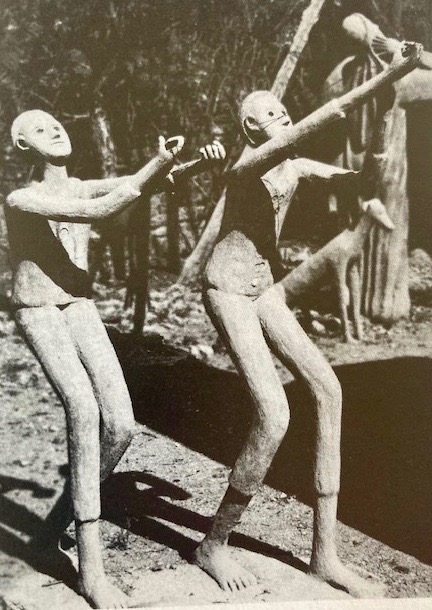
And as much as they tried, the beautiful concrete children she and Koos, her helper had made in her yard, pulling a rope attached to the arms of the little model of the village church clock and all it represented, could not hold “Time” back.
In the end, she crawled, black-tongued, to her neighbour, who took her to the hospital in Graaff-Reinet. The irony of her terrible suffering was that she chose such a painful method to end her emotional pain. It creates more pain, just as the painkillers create more pain when you use them too long.
When she drew her last painful breath and let go in the Graaff-Reinet hospital that August night, the nurse sitting with her noticed an owl come to the window as if to pay homage. When her body gave up, the owl took flight.
Her dear friend Gill Wenman drove all the way from Cape Town that day to see her. She was the one they called to positively identify her body. She was her next of kin. (Kin is a word meaning kindred, it does not have to mean family, it may refer to being of the same spirit.)
When they showed her Helen’s body. Jill said she looked like a withered dead bird. Jill then drove to the owl house and freed all the birds Helen kept in her aviaries except for the tame doves. These she put into her Volkswagen beetle car and drove them all the way to back Cape Town. She had birds sitting on her head and shoulders all the way.
(This is what our great writer friend told us when he came for tea one day, and I will never forget the way he told us that story, sitting on the back patio, he told stories with such passion. He was the one and only Athol Fugard. He came to visit quite often as I was growing up and was a great mentor. He had done deep research about this by hearing the story from Jill herself in preparation for his play “The Road to Mecca.”
Helen Martins’s spirit and the works she made at her Owl House still haunt the town of Nieu Bethesda. Over the years, her artworks have brought many seekers and travellers to the village to wonder at the stories she made in concrete and glass. The shadows of wise men riding their camels, still pass over the hot sand in the yard as they move in their stillness, in the direction of the star in the East.
The story they tell is a story of hope, change and light.
It is a story of something new, a promise, and a sign of something very important coming in the future to transcend the paradigms of mundanity. Something we should all be aware of. Something Helen wanted us to know very urgently. It was her message to the world. Her legacy. I felt it.
I have seen it coming too.

So here we are on earth. We can’t get this moment back, life is short and each moment spent with someone special may be the last. In this time we call the present, I have learned, that the perception of ourselves and others as different is directly linked to the story of separation. We have the option of sitting passively and watching, as if separate, or realizing our part in it, and taking action. Taking action means stepping into the river, the path, and the flow of energy that leads you forward to follow your purpose.
It means overcoming one’s fear of the unknown and finding the courage to implement the decision to do what is right for yourself and the world as we are all part of it. The path forward is to be kind. Kind to your own heart and kind to others, great and small, and not to isolate each other with intimidation and bullying, for being and thinking differently, but to appreciate each flower for its own precious properties. We need to learn to pray, by standing on our knees on the earth. When one stands on one’s knees, it’s easier to tune into your heart, and be humble and aware, that we are equal. Nobody is more special than anyone else.
These are the lessons I learned in the past few years as a student of a great teacher, as a wounded healer learning to heal myself. Thank you Zanemvula. Camagu.
 Helena Kingwill - Earthnotes for hope
Thank you for sharing your beautiful writing with us, Helena. I look forward to reading your memoir when you have completed it.
Sending you my love at this special Christmas-time of year,
Victoria x
Thank you Victoria. I appreciate the encouragement and appreciation. Have a lovely Christmas too.
Thank you Victoria. I hope 2024 brings you blessings.